|
Married 1845 Sarah A.
Finley 15 Nov 1823 - 5 Jul 1888
6 James Horn Williams 1/15/1826 - 1/12/1893 (My grandmother's grandfather)
Married in 1847 Mary
E. Finley, b. 15 Sep 1818, d. abt 1857
Second marriage
in 1858 Juliette Marian "Nellie" Heath
Third marriage
in 1874 Mary Duncle
Forth marriage
in 1882 Sarah A. Dunavant
Married in 1855
to Frences Brennan 1834 - 1869
8 David Dwyer Williams 1/11/1829
- 2/17/1829 (Died as an infant)
Married 1845 Dr. William
Harvey Whitaker 1820 - 1888
Married 11 Mar 1852 James
Cartwright Warner 1830 - 1895
Married 4 Dec 1855 to
Susan J. E. Sample, Married in 1867 to Mary Burton.
Married June 6, 2854 to Andrew
Jackson "Jack" Duncan 1856 - ?
Married 15 Aug 1855 Dr. William
Eggleston Kennedy 1823 - 1862
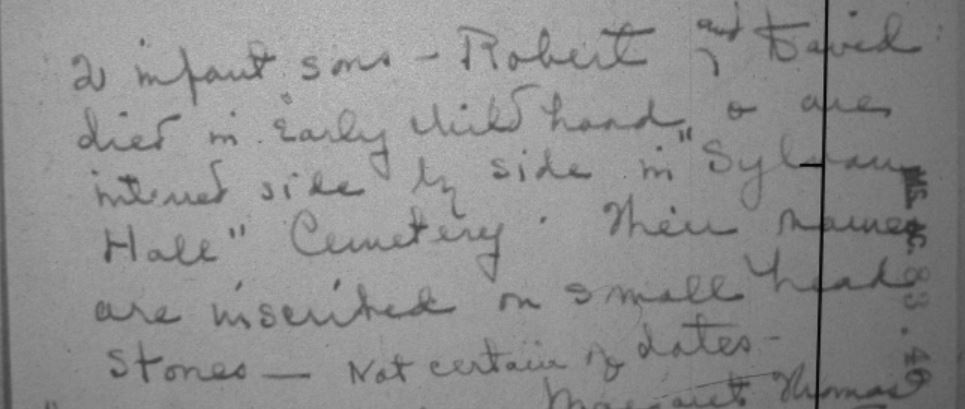
14 Robert Williams born after 1838 and may not have survived.
The following note was included in over 100 pages of notes written
by Mrs. George A. Frazer, 302 Cornwall Ave., Nashville, TN and filed in the Tennessee State Archives and Library. I
have been unable to locate the grave marker referenced in this note.
After James Cartwright and his wife Mary "Money" Thomas Williams
died, their son Percy Warner and his family moved from Renraw to Royal Oaks, a 20 acre estate, on Harding Road in 1913.
The property was sold in 1940 and the house was razed in the 1960's.
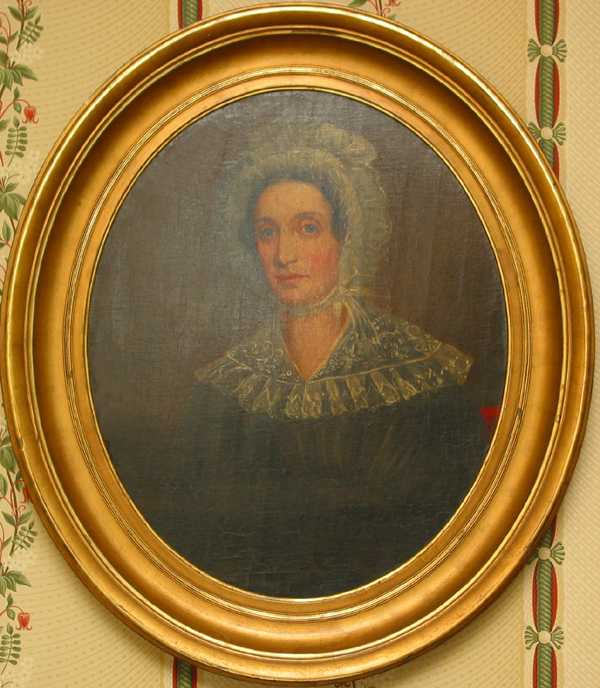
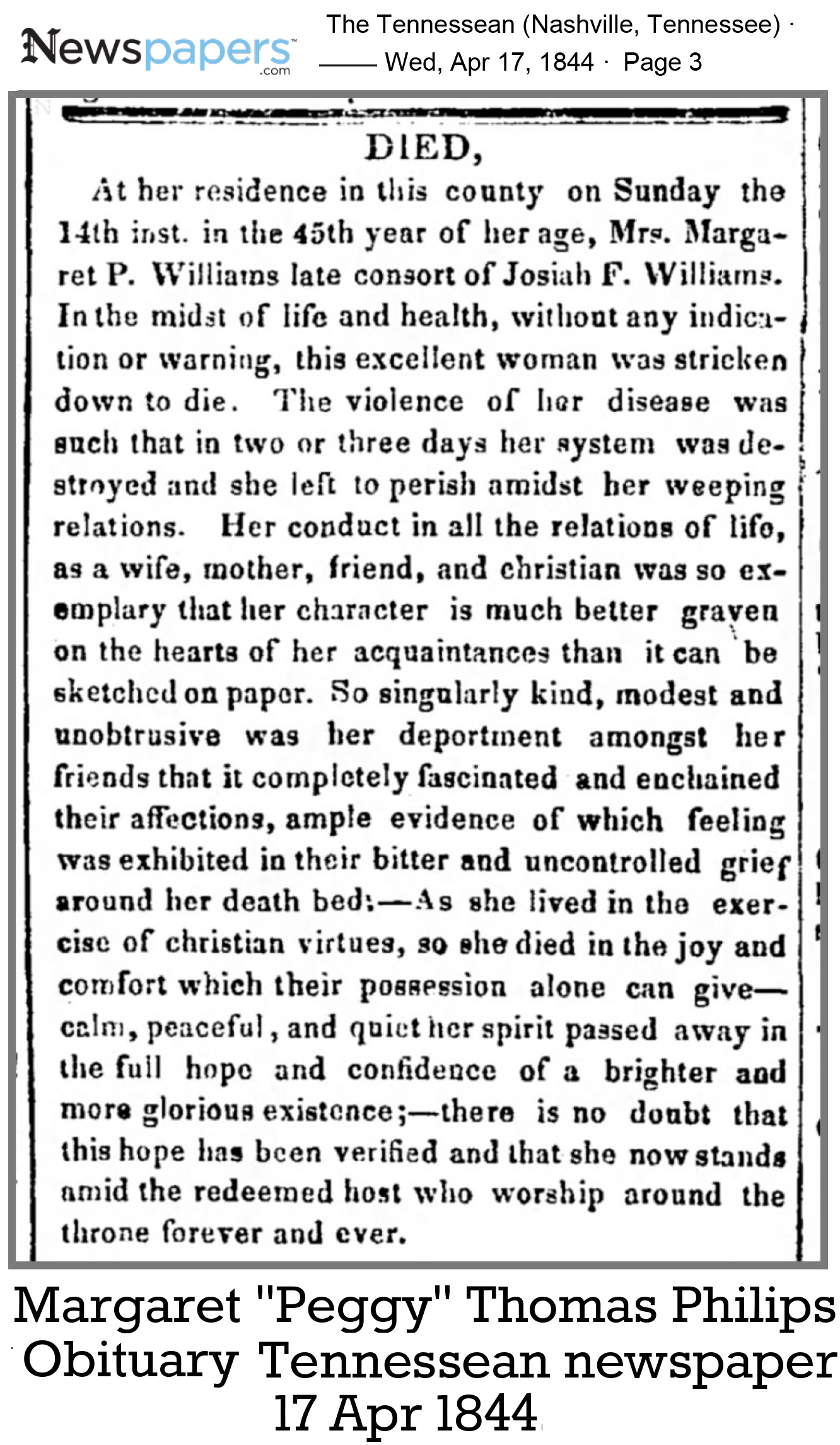
The above paintings of Percy's mother's parents, Josiah Frederick Williams and Margaret "Peggy" Thomas Williams,
were displayed above the built-in bookcases in the Royal Oaks room below.

 |
|
The University of North Carolina formally
opened Feb. 12, 1795 and Josiah attended there the 1803-1804 school year and was a member of the Philanthropic
Society.
The objects of the Society were and have continued to be two-fold. First, the improvement
of its members in the science and art of debating, in English composition and the attainment of a good style, in the knowledge
of parliamentary rules and modes of conducting public business. Secondly, the cultivation of moral and social
virtues, and the formation of lasting friendships, founded on co-operation in honorable works.
Click here to read the UNC Philantrophic Society web site.
The book " Philanthropic Societh, Instituted in the University of North
Carolina, August 1st, 1895", Fourth Edition, Published in 1887 lists members of the Society. Josiah
Williams is listed as being an active member in the year listed, but not being a graduate of UNC. He is listed as being
deceased when the book was published in 1895. In 1803 he was living in Franklin County NC with his parents and siblings.
1803*WILLIAMS,
JOSIAH . . . . . Franklin Co.
According to Gerri Williams, the UNC records show Joshiah
Frederick Williams being enrolled "03-04, 1807" which I interpret to mean that he attended the school year 1803-1804 and would
have been in the graduating class of 1807 had he stayed in school. He likely left school to move to Nashville TN with
his family in 1804 or 1805.
From the Raleigh Manerva Newspaper 4 July 1804 University of North Carolina Students End of Year Evaluations
Josiah Frederick Williams is listed among those completing the
Sophomore year.

|
|
|
|
|
|
|
Below are sections of the 1810 and
1812 Davidson County Tax Rolls showing Josiah Frederick Williams with 476 acres and 25 blacks, his brother William Williams
with 919 acres and 17 blacks, and their mother Sarah Williams with no land and 7 blacks.



Below
are deeds for other properties purchased by Josiah Frederick Williams as listed in the Davidson County Deed Books.
On 1 December 1815 Josiah purchased 101 acres in Davidson County from
his Father-in-law Joseph Phillips (Philips) and recorded the purchase on 13 December 1815 in Deed Book M page 74.
|

|
On 15 July 1818 Josiah F.
purchased 183 acres on the north side of the Cumberland River from his
brother William Williams and recorded the purchase on 29 March 1819 in Deed Book
N page 135.
|

|
On 27
August 1830 Josiah F. purchased 300 acres on Jones Bend from his brother-in-law Jesse Wharton
and recorded the purchase on 19 November 1830 in Deed Book S page 659.
|

|
On
20 November 1815 Josiah F. purchased 133 acres on the south side of the Cumberland River from Shadrack
Cayce and recorded the purchased 29 March 1819 in Deed Book N page 136.
|

|
On 28 January 1837 Josiah
F. purchased 70 acres from Elijah Wilson etal and recorded the purchase on 28 January
1837 in Deed Book 1 page 70.
|

|
Below is an advertisement that appeared
in the Tennessean newspaper on 19 May 1843 regarding a Chancery Sale of 117 1/2 acres that Josiah F. Williams had sold to
Mary Ann Austin being the tract of land mortgaged by Wilson & Brooks to Josiah F. Williams on 28 Jan 1837. Not sure
what this was all about.
Found on newspaper.comNewspapers.com
|
|
|
|
The following undated letter from Robert Ewing, son of Andrew Ewing and Rowena Williams Ewing, sheds some light
on the Maplewood plantation and the lives of the children. Robert Ewing was Secretary and Treasurer of the Watkins
Institute in Nashville at the time he wrote this letter.
Mr. Anderson,
I regret that I am not able to give you as accurate information
with regard to Maplewood as I would like to give you ----
My grandfather on the maternal side, Josiah Williams, owned a very
large tract of land (I think about 1,000 acres) situated on the west side of the Gallatin Turnpike about five miles from Nashville. Whether he inherited this tract or aquired it by grant I do not know.
He established his home there several decades before the civil war. The place was covered with magnificent trees, the maple predominately, and because
of this, as I surmise, he gave the place the name of “Maplewood”. It
was equipped with all of the facilities necessary to handle plantations of that size as they were handled in these early days,
with saw mill, grist mill, blacksmith and carpenter shop, cloth weaving and C supplying all the needs of his family and those
living on this tract Timber of all kinds was at hand. He built the house on an elevation back westwardly from the Pike, leaving
a lawn in the front covered with royal sugar maple trees. Walnut was plentiful in those days and the flooring of the rooms
of this house consisted of walnut plank an inch thick obtained from trees growing on the land and prepared in the shop on
the place.
Mr. Williams married Margaret Philips. Fourteen children came from this union as follows:
Milbry - Married Orille Ewing 5th, President of
the old Planter Bank
Rebecca
- Married Edwin Ewing, Lawyer of Nashville
Three sisters married three brothers | Rowena -
Married Andrew Ewing, Lawyer of Nashville
Sarah - Dr. Whittaker, Physican of
Clarksville
Henry
- Farmer of Guthrie, KY
John
- Merchant of Nashville
James
- Merchant of Clarksville
Elisha
- Farmer of Arkansas
Martha
- Married Andrew J. Duncan, Merchant and Banker of Nashville
Mary
- James C. Warner, Iron Manufacturer
Margaret
- Dr. Kennedy, Physician of Chattanooga
Jerre Baxter afterward bought the place and gave a site thereon
to the Mason’s for an Orphans home.
When Mr. Baxter started to remodel the house Williams had built
the contractor told him he could never replace material as desirable as that than existing.
This is such a crude statement
that I prefer you do not mention my name though I think it correct. The other
three children whose names are not mentioned may have died in infancy. I don't know.
Your friend,
Robert Ewing, Son of Andrew
Following is copy of the original hand written letter.
Robert Ewing Ltr by Larry Feldhaus
Henry Philips Williams, the seventh surviving child of this union, wrote a letter in 1892 or 1893 which included the following:
"The family moved to Tennessee in
1804 I think, and your Grandpa Josiah Williams married Margaretta Phillips in 1815 and had twelve children; James Williams, your father was one of the twelve.
Speaking
of our family I should tell you that your great-Grandpa was highly educated and of quite
a literary turn. He was wealthy and gave all his children finished educations.
Cousin Jack's father was a graduate of Harvard University, Massachusetts and your grand-uncle
Elisha and your Grandpa were graduated from Chappel Hill College, North Carolina.
Both read latin fluently and their handwrite was most excellent.
In mathematics he was superior to any of his boys. I have heard him say
that his father was one of the best read men in North Carolina, and that his Grandfather was highly educated. Grandfather Phillips was a close personal friend
of my Grandfather Williams and finally induced him to move out to Tennessee. He selling
his real estate and giving part to his daughter Elizabeth who married a wealthy man in North
Carolina named Thomas Alston. You may not know it but my Father and my Uncle (Jack's Father)
married sisters, Sally and Margaretta Phillips, and through Grandfathers Williams
and Phillips all the fine real estate near Nashville was inherited by Cousin Jack's father which is now known as the William's Estate."
Henry included with the letter a family history, a part of which follows:
"Your Great Grandfather, Elisha Williams, was highly educated himself, and insisted that his children should have every advantage
extended to them in getting a collegiate education, which was something unusual at an early day.
He employed a private tutor for his boys, and when they were sufficiently advanced in their studies, he sent the oldest (Uncle
William) to Harvard University, Mass., and your Grand Uncle Elisha and your Grand Pa to Chapel Hill, N.C. All three got their
diplomas, and I know myself that your Grand Pa Williams could read Latin fluently and wrote a beautiful fluent hand.
Cousin Jack spoke of the old original stock as coming from Wales and settling first in Pennsylvania, and at least one branch
of the family immigrating or moving to North Carolina. That branch from which we are sprung came some time in the early part
of 1725, and settled in or near Edgecome, N.C.
Afterwards the head of the house, William Williams (father's grandfather) moved up to a place called Shoco or Shoeco, in Caldwell
or Halifax, County, N.C., where he bought a large and fine property and lived the life of a country gentleman, having his
farm on the river, his Negro quarters and his overseers. He had, I think, three sons and several daughters.
One of these sons was my grandfather, Elisha Williams, born in 1746, and afterwards owning the homestead, besides several
farms in Franklin County, where I am told they kept Negro quarters managed by overseers.
He married a Miss Josey in 1774 and his children were William, born 1776, Elizabeth, 1778, Elisha, 1782, and your grandpa,
Josiah F. Williams, born 1786.
In 1808 or thereabouts the family moved to Tennessee, leaving their married daughter, Elizabeth Alston, in North Carolina,
where her descendants are now living, her only daughter having married a man by the name of Williams.
They had two children, Tom Williams and Lucy Williams. Lucy was quite an heiress and married William Polk (President James
K. Polk's brother), while Tom and his children, when I last heard from them, were in fine circumstances.
Now my dear boy, after the family moved to Tennessee, you may be able to write out the remaining chapter.
Your Grandma (Margaret Philips) was born in 1799 on the place owned by her father, Jos. D. Philips, six miles from Hasville
on the Dickenson Pike, and one of the finest places in Tennessee.
Josiah F. Williams was married in 1815, and in 1817 built the brick house which Jerry Baxter bought. It was one of the first
brick houses built in the County of Davidson. I think your Pa was born about the time they moved into their new home, 1818."

The picture above came from a book entitled "Beautiful and historic homes in and near Nashville,
TN, compiler - Mrs. James E. Caldwell and the co-author caldwell, May Winston. I found it in the Nashville Public Library
Main Nashville Room under call number 917.68.c141b. The following text was on the page with this picture.
This beautiful
farm of fourteen hundred acres, situated four miles from Nashville, on the Gallatin Pike, will always be a spot of interest
to the people of this community on account of the owners and occupants who have lived and loved, married and died there.
The
residence was built by Colonel Josiah Williams of Chapel Hill, North Carolina. It was one of the first brick houses erected
in this vicinity, and, in its day was considered a model of architectural beauty and elegance.
Maplewood was the
scene of the marriage of three of Colonel Williams daughters to the three distinguished Ewing brothers, Edwin, Andrew and
Orville. Mrs. Andrew Ewing was the mother of Mrs. Henry Watterson. On the occasion of her marriage the weather was so cold
that the wedding guests were driven across the river on ice. The other daughters were Mrs. James C. Warner, Mrs. A. J. Duncan,
Mrs. Whitaker, and Mrs. Kennedy.
From Colonel Williams the place passed into the possession of Dr. David W. Yandell,
who afterwards moved to Louisville and became one of the most eminent physicians of Kentucky. He was the uncle of the sculptress,
Miss Enid Yandell.
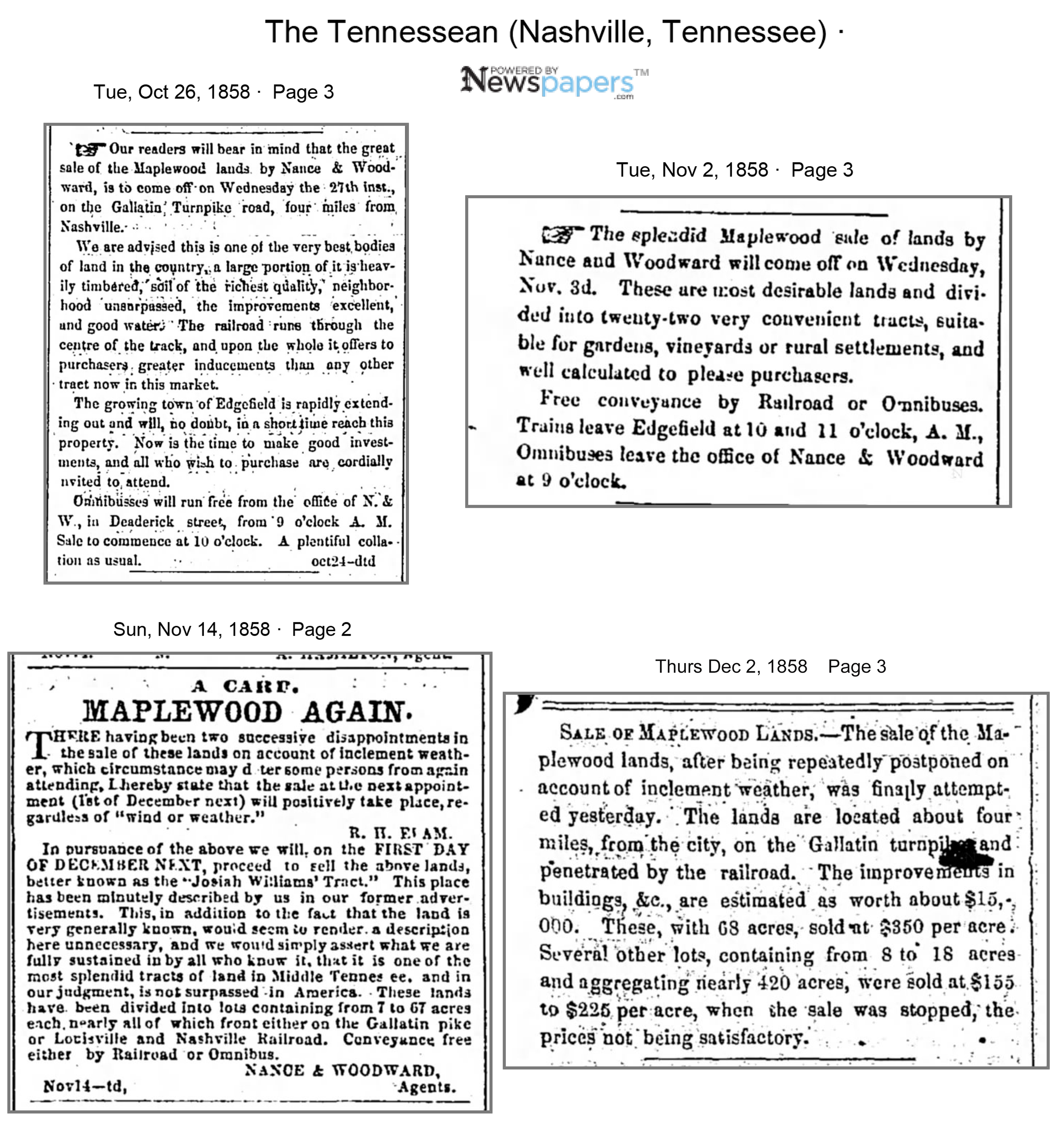
Below is and advertisement in a Nashville newspaper for the
sale of Josiah Frederick Williams land, totaling at least 488 acres, which did not sell at auction because it did not bring
a high enough price.
Dr. Yandell sold the place to Mr. George W. Payne, grandfather
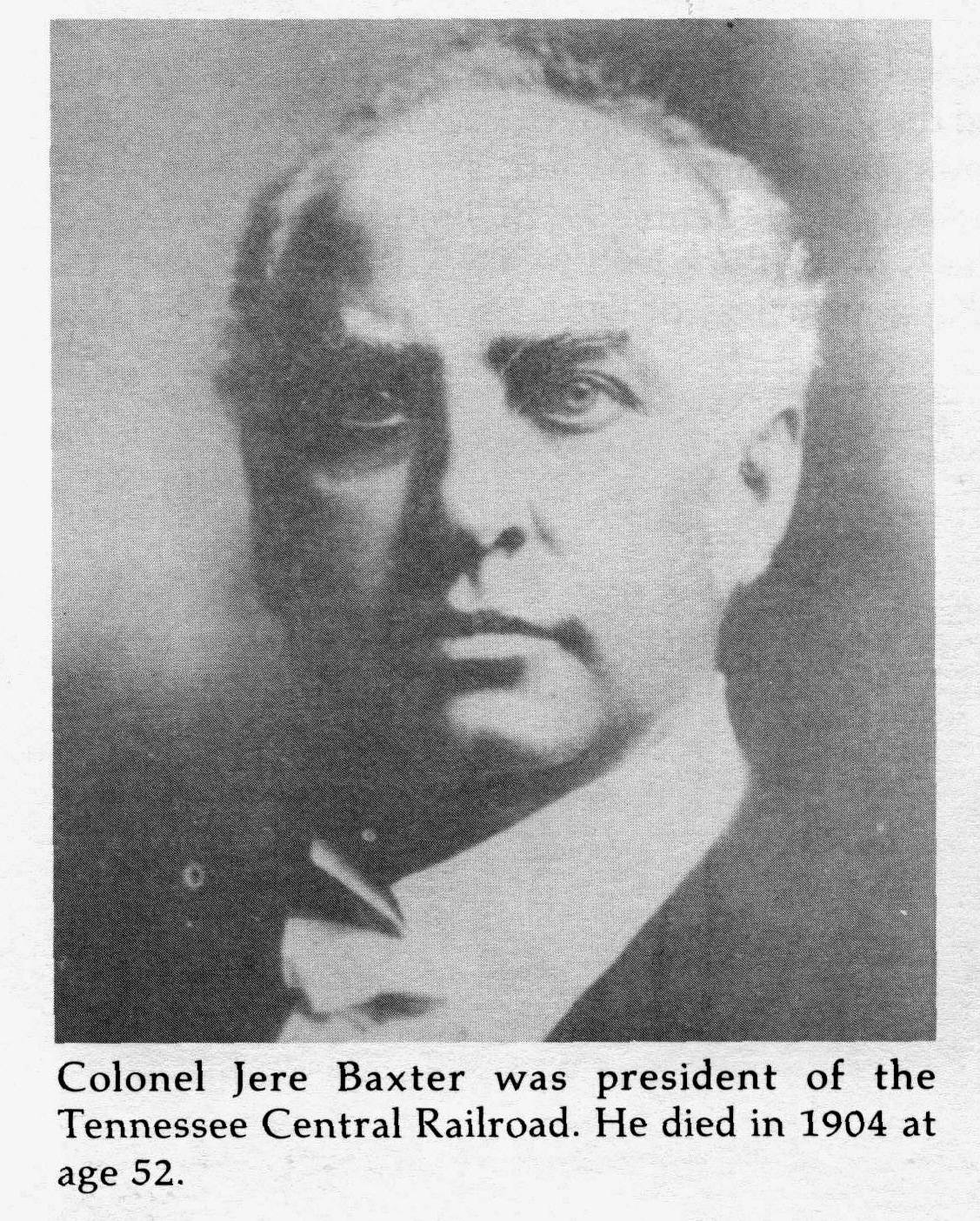
of Miss Mary Hannah Johnson. The next owner was Colonel Henry Blood, who sold it to Colonel Jere Baxter.
Colonel Baxter improved the place, retaining intact, however, everything of intrinsic beauty. The old flower garden and the
fine lines of the Colonial house were left undisturbed - not even the interior was touched except to put in modern conveniences.
The paneled doors, high mantels and the quaint staircase were retained.
Colonel Baxter had for many years been a collector
of objects of art and Maplewood was filled with treasures brought
from all over the world. There was also an extensive library, containing many volumes of rare editions.
Colonel Baxter
imported direct his Welsh and Shetland ponies, Holstein and Jersey cattle, and Norman and Percheron horses.
He gave
fourteen acres of the land to the Masonic Widows' and Orphans' Home. He added the McIver place to Maplewood,thus greatly extending
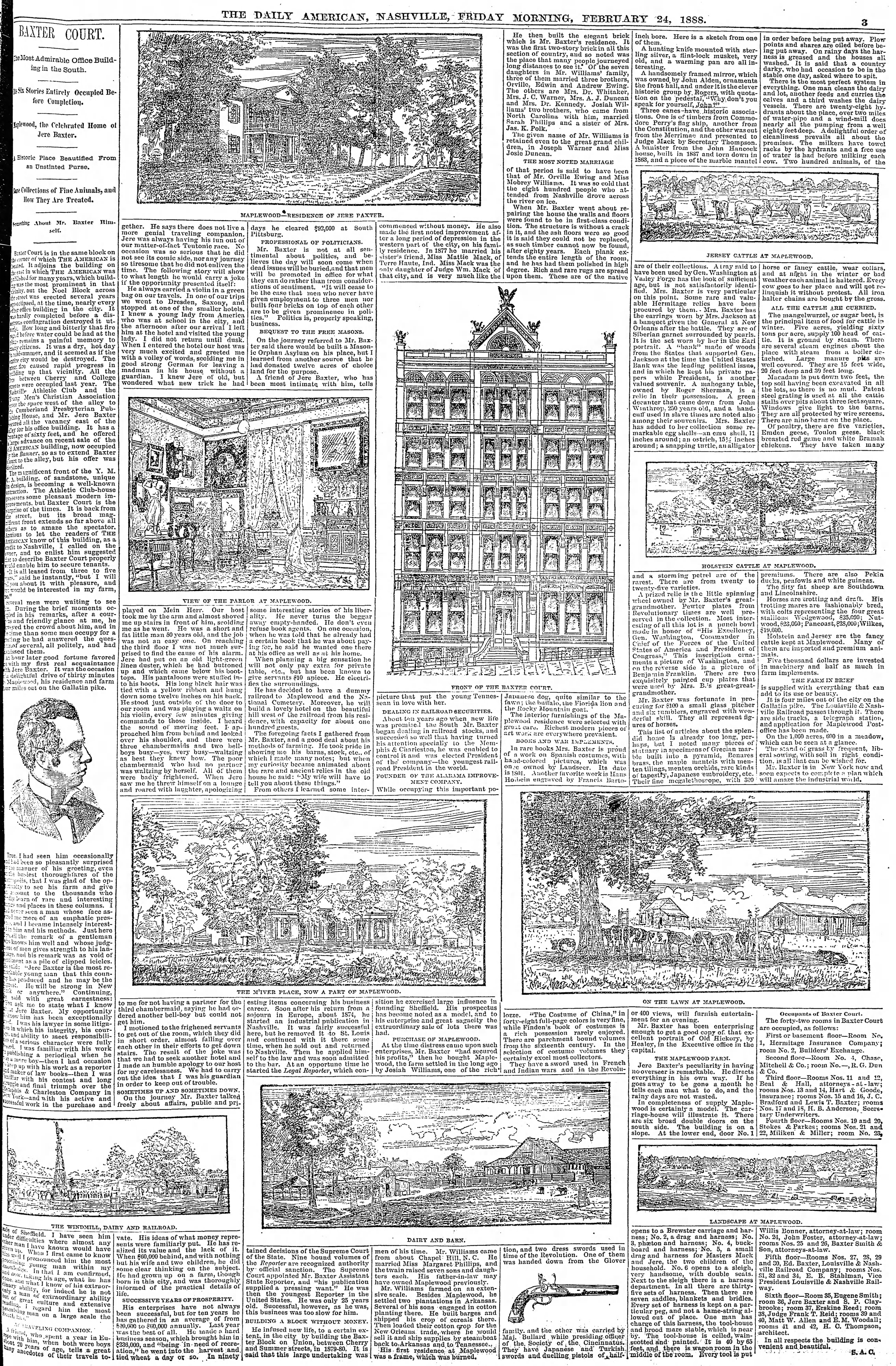
the property. Below is a newspaper article from 24 Feb 1888, a little over
32 years after Josiah Frederick Williams died. The story cronicles the history of the plantation, at that time
1,000 acres. A portion of the story covers Williams family, the prior owners. I would love to see the original
pictures that were included in this story. The ones in this copy are hard to see. I obtained this copy from Newspaper.com. As usual, you can click on the paper to see a larger size that
is easy to read.
When the city grew out to the farm and made the land very valuable,
Colonel Baxter was persuaded to sell it to a land syndicate, and with him passed from Maplewood
its last individual owner.

The house and the last 27 acres of Maplewood were sold at auction by the owner, Jere Baxter on 4/23/1922.
Below is a map of the area showing the roads in green as they probably existed when Josiah Frederick Williams lived there.
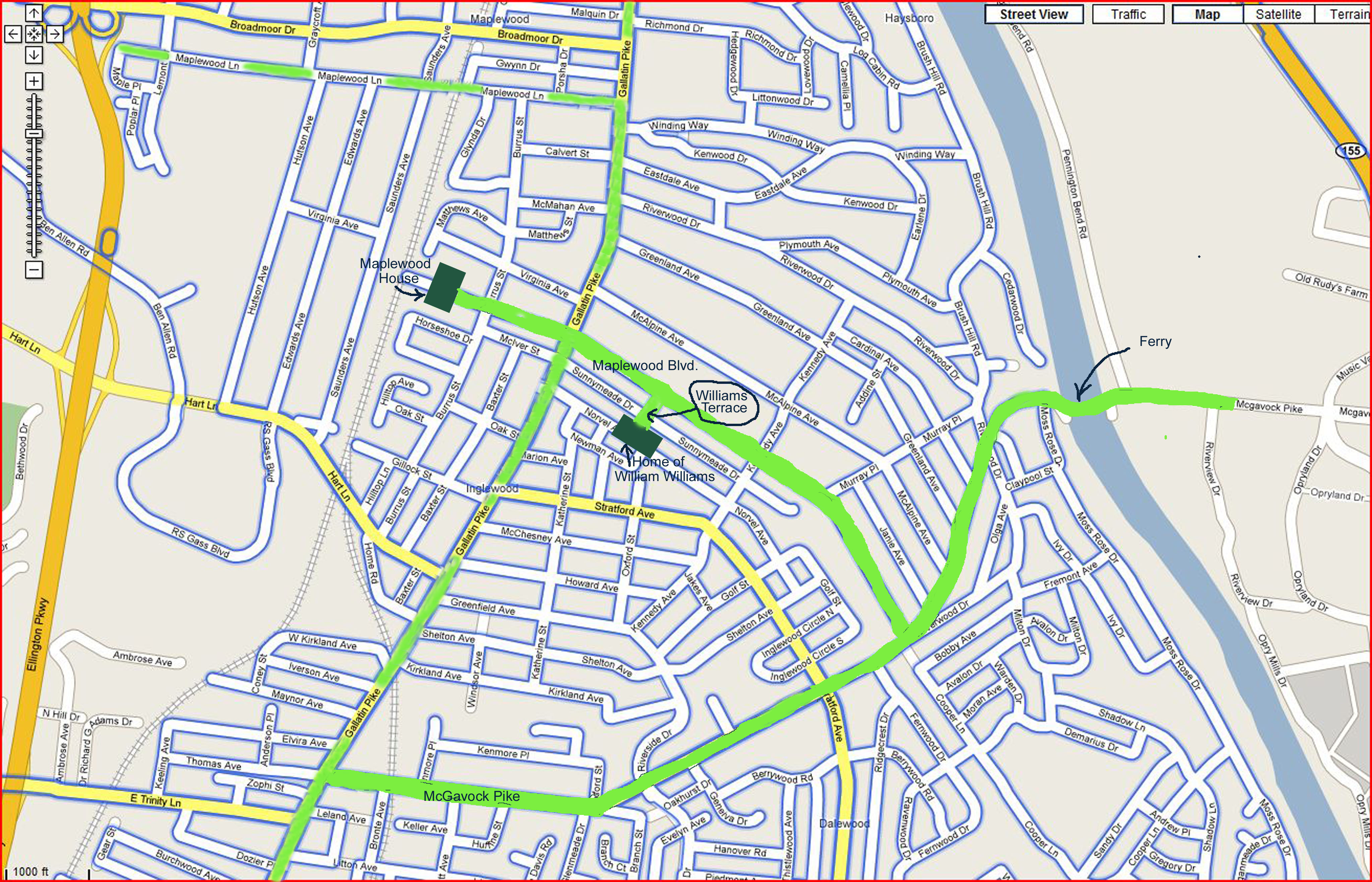
This location is just south of Briley Parkway
on Gallatin Pike. The railroad is just behind the location where the house was. Maplewood Blvd. is now Curdwood
Blvd. and has been extended through where the house stood. You can click on this map and see a larger view of this map
in a new window.
It appears that Maplewood Blvd. extended across
Gallatin Pike to McGavock Pike and passed in front of William Williams' house. Williams' Lane still exists. According
to one account, Elisha's house was on the hill behind Wiliam's house near the spring.
It appears that Maplewood Lane represented
the northern boundry of Maplewood. Today Maplewood Lane is broken by Ellington Parkway and continues on the other side
to Dickerson Road where Maplewood School is located. By one account, the Maplewood property extended to Dickerson Road
at one time.
Gallatin Road
PRIVATE ACTS OF
SUMNER COUNTY, TENNESSEE
Private Act of 1829, Chapter 232, incorporated Thomas Martin,
William White, Robert Weakley, Josiah
F. Williams, Elijah Boddie, Robert M. Boyers, James Saunders, Isaac Walton,
and Daniel Montgomery, along with others, as the Gallatin Turnpike Company, to lay
off and construct a turnpike road from Nashville by way of Gallatin to the Kentucky State
line at the most eligible point in the direction of Glasgow, Kentucky. Details of the corporate
management and a schedule of tolls which could be charged were included in the Act.
A History of Tennessee and Tennesseans: the leaders and ..., Volume 2
By Will Thomas Hale, Dixon Lanier Merritt
The Nashville and Gallatin Pike was
chartered in 1830. It was over this highway that General Jackson made his journeys to and from Washington.
The following tradition is connected with the road: A resident of
Sumner county, who came daily to his business in Nashville, disagreed with the company as to
his indebtedness, and suit was brought. He refused to pay toll while the suit was pending. Result, many wordy altercations
between the debtor and keeper.
Having been refused passage several times, the citizen stowed away
in the bottom of his buggy an axe and when he reached the gate and was again refused passage, he proceeded to cut the tollgate
pole down. When he had repeated this several times, the company decided that repairing the gate
was more expensive than letting him pass and he had no further trouble.
This pike was chartered by Thomas Martin. William White. Robert
Weakly, Josiah F. Williams. Elijah Walton and
Daniel Montgomery.
Below is a copy of Josiah Frederick Williams will as it appears
in the Davidson County TN records.
target="new">
|