|
Most of the information on this page was obtained on 11/5/2006 from Geraldine (Gerri)
Williams whose husband decends from this line of the Williams family.
|
|

|
Frances Brennan is the first wife of Henry Philips Williams.
|
The children of Henry Philips Williams and Frances
Brennan are:
Thomas Brennan
Williams, died at 11 years old
Rowena Ewing Williams, married Charles Morris Day II and produced five children:
Mary Frances
Henry Philips
Rowena "Tito"
Charles Morris III
Harry Williams Day (died as infant)
(named after uncle)
Marguaretta or Gretta Kendall Williams (never married)
Harry Lee Williams, married Virginia "Vivy" Vance Nicholas and produced two children:
Carter Virginia
Rowena Hickman
Frances "Fannie" Victorine Williams (died as infant)
Frances Brennan Williams
Boddie, the last child and daughter of Frances Brennan and Henry
Philips Williams married Nicholas Van Boddie and later married Allan
Sanford.
She is buried with him in Waco,
TX
along with her daughter Frances Van Boddie who married William Topping
Merry.
Nicholas Van Boddie is the son
of
Willie Perry Boddie and Martha Rivers McNeill.
|
|
Tennessee Stark Williamson was Nannie's
mother: Her Grandfather was an aide to Andrew Jackson at the Battle of New Orleans.
Nannie's brother Ben was in Company A 14 Tennessee Infantry, 1st Sergeant and 2nd Lieutenant.
He studied medicine but didn’t complete the course. He was a surgeon in the Forbes Bivouac. He
never married. He served under Robert E. Lee in VA. He fought in the battle of Gettysburg and was captured
and imprisoned on Johnson’s Island in Lake Erie for 18 months til the end of the war. His tombstone says
he was a Confederate Vet 1st Lt. of Company A with the Tennesse Regiment + CSA
Nannie's brother Robert James Haskins fought in the battle of Ft. Donelson and he was captured
and imprisoned in Ft. Dearborn, IL and died in prison.
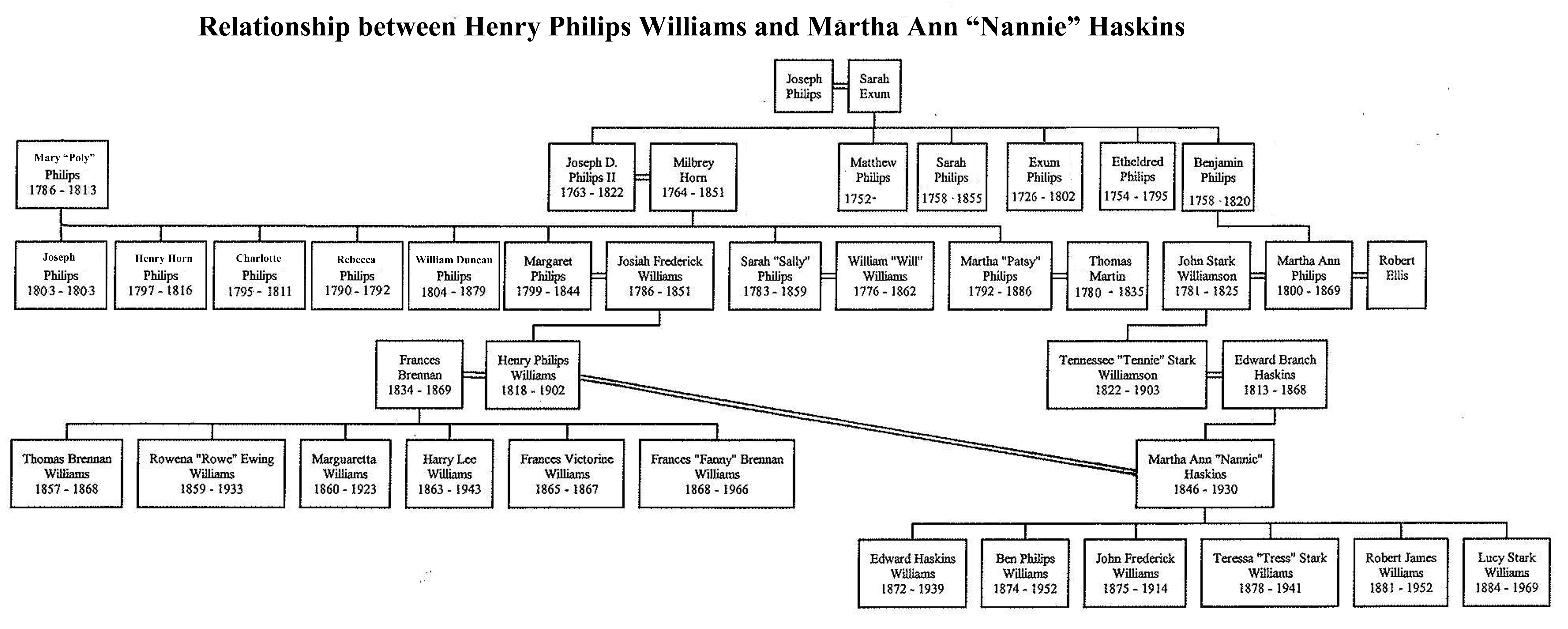
Nannie is a distant relative
of her husband Henry. Their
relationship can be seen in the below partial family tree. She is a maternal
great granddaughter of
Benjamin Philips who is a brother of Joseph Philips, the maternal grandfather
of Henry Philips Williams.
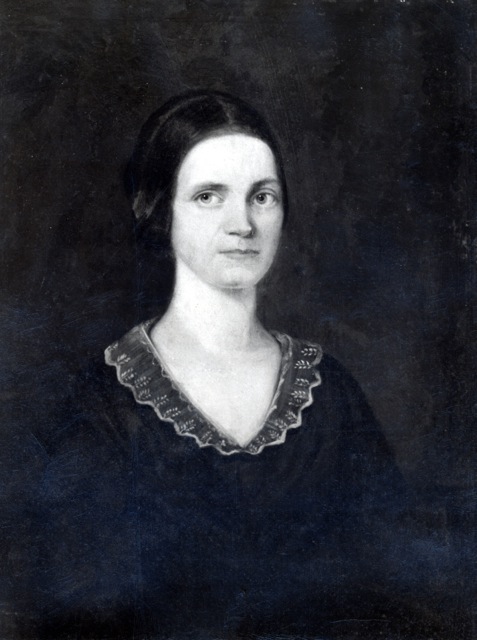
Portrait of Nannies mother, Tennessee Stark
|

|

|
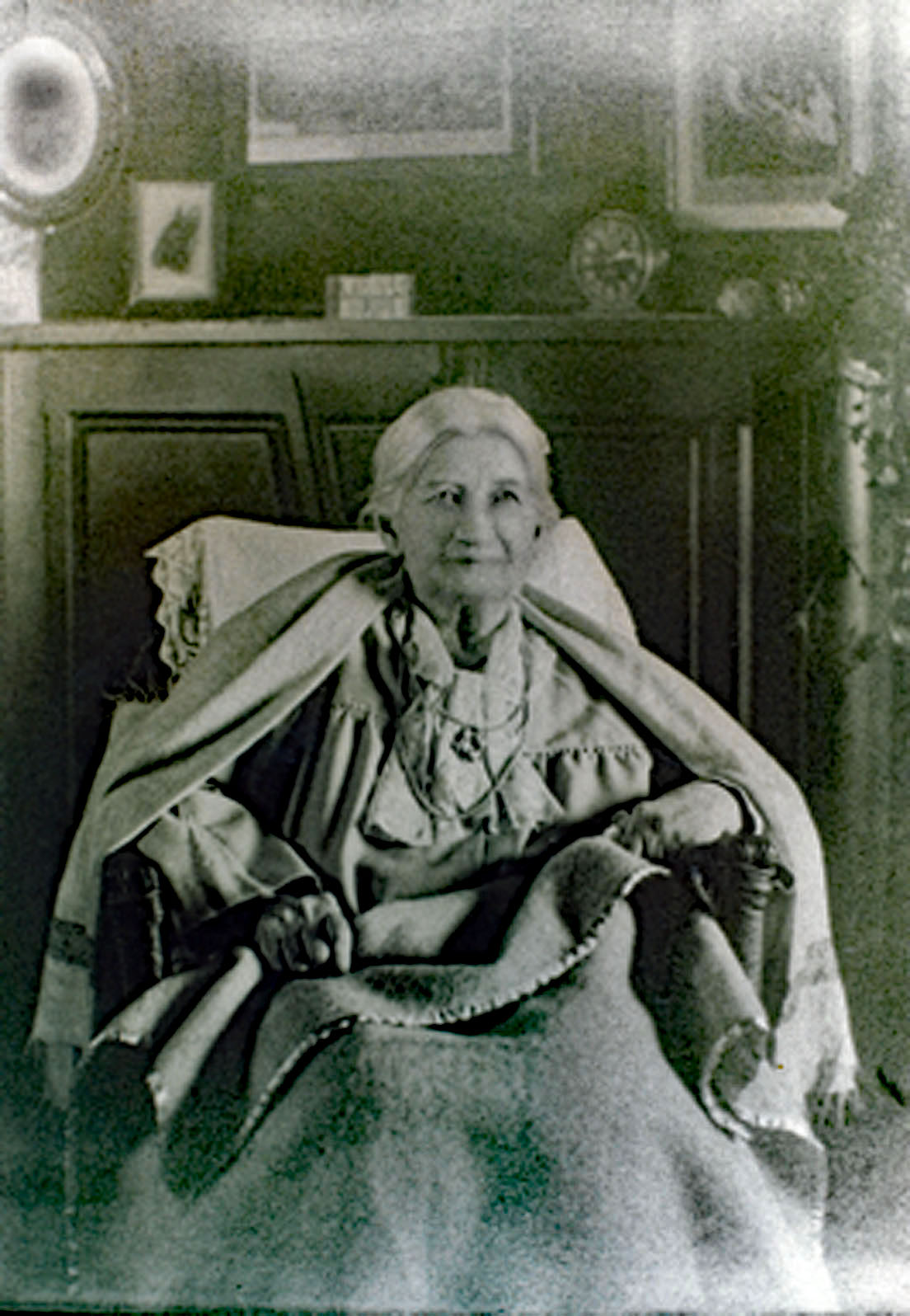
Gerri Williams gave me the photo to the left of an older Nannie Haskins in 2013. Gerri Williams was told that the family was very close and that Henry's second wife Nannie (Martha Ann
Haskins) raised Frances' children as if they were her own!
Children of Henry Philips Williams by Martha Ann "Nannie" Haskins are listed below. Above
is a "contract" Nannie had sons Ben and John sign one year.
Edward Haskins Williams married Berta "Bert" West
and produced Henry Philips who died as an infant and Emily West. (his descendants live in Alabama)
Ben Philips Williams married Cora Blackwell and produced Eleanor Branch Williams. He then married Marion
Bakerand produced Adrian, Nancy Haskins Baker, and Ron. (descendants live in MO)
John Frederick Williams (Gerri's husband's grandfather) married Anne Nottingham "Nan" McKown
and produced Nick Van Boddie Williams, Henry Philips Williams and John Frederick Williams. The last two had no children.
Teressa "Tress" Stark Williams married Dr. Newman Ross Donnell and produced Jess Franklin Donnel,
Newman "Ned" Ross Donnell, and Ben Philips Donnell.? (descendants in MO and Washington DC)
Robert James Williams married Orena Roselle "Rena" Dryer and produced Robert James II, diane, and
Haskins. (Descendants in Birmingham, AL)
Lucille "Lucy" Stark Williams lived to 86 (never married)
Nannie married Henry in 1870 and they lived together at Greenleaf, near Guthrie, KY, until Henry died around 1900.
Nannie then sold the farm and moved to Birmingham where several of her sons were working in the iron business. She lived
in Birmingham until shortly before her death when she and her youngest daughter Lucy moved back to Clarksville.
|
 |
|
|
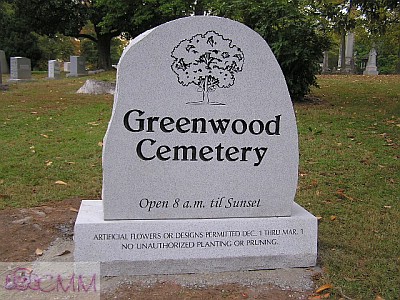
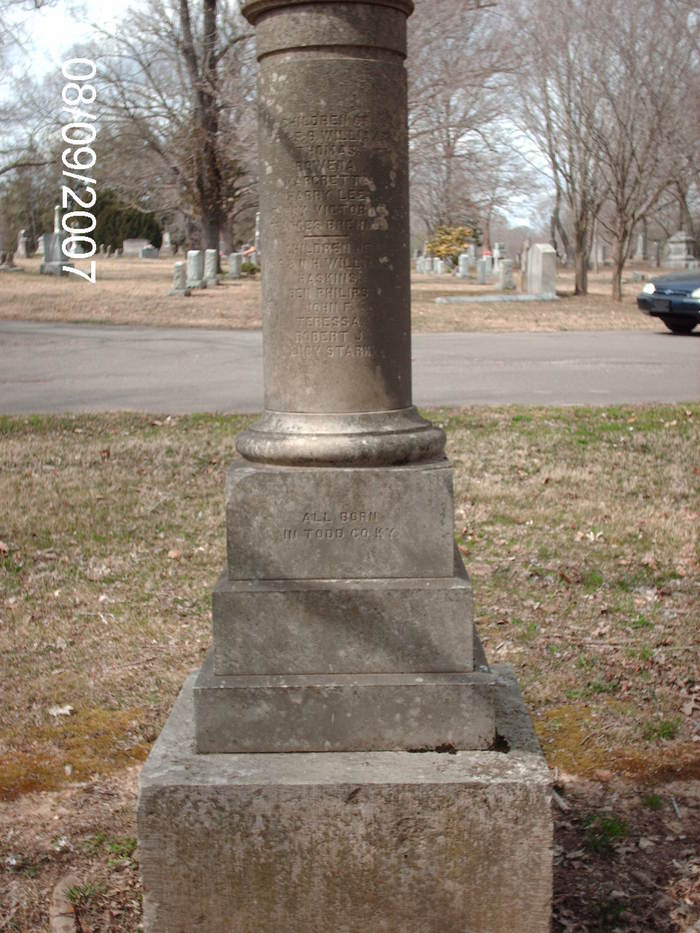
Located in downtown Clarksville TN
|
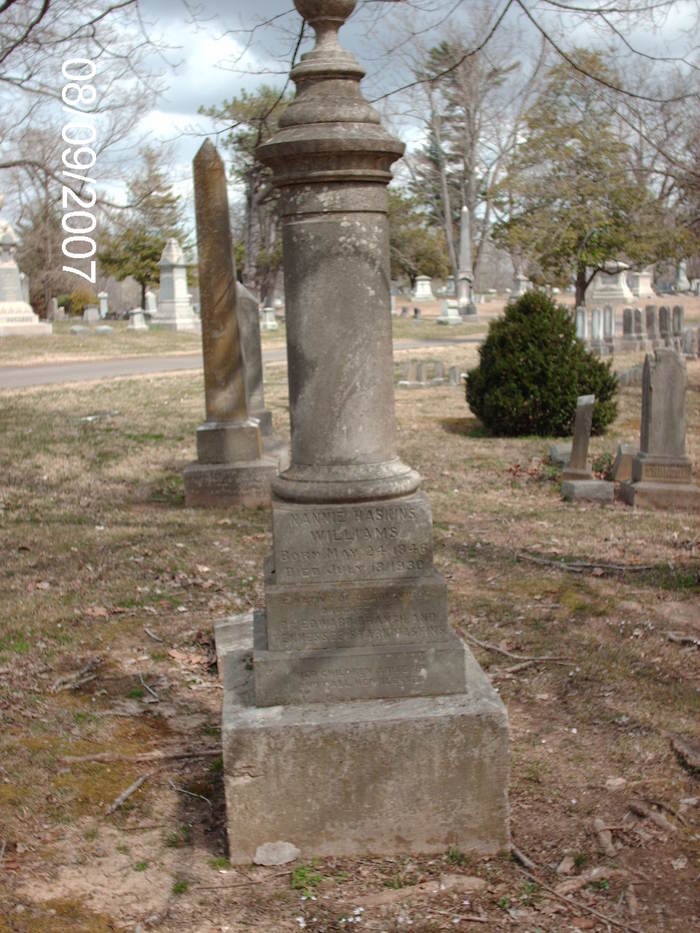
Side with Nannie Haskins Williams
|
|
|

Side showing Henry Philips Williams
|
|
|
|
The following information was taken from pg. 23 in "Todd Co., KY Family History", Turner
Publishing Co. Paducah, KY 42002-0121=
Henry was one of the sons of Josiah Frederick Williams and Margaret "Peggy" Thomas
Phillips who owned the Maplewood plantation on Gallatin Road about five miles north of Nashville, TN.
Henry's home, “Greenleaf”, was one mile north of Graysville, Todd Co.
KY. Graysville was 2 miles west of Guthrie, KY.
The land was owned originally by Joseph Washington and his son George, who developed the large
13,000 acre estate in Robertson Co., TN with Washington Hall, Wessyngton and Glenraven mansions,
once considered a very promising area for development.
Joseph started buying plots of land in south Todd Co. in early 1800s. In 1841, he deeded 750 acres
to his son, George A. Washington. Joseph died in 1848 and the son, George decided to sell his Kentucky land and
develop the Tennessee holdings.
He sold 1329 acres to Andrew Ewing and Henry P. Williams in 1855. A portion of this estate
is now the home of Mrs. Wilbur Gregory. it was known earlier as the Tom Mimms or Doc Nabb place. It’s
location is about one mile north of Old Graysville, on Hwy. 181.
|
|

|
This picture was taken on Nicholas Boddie's porch, somewhere near Guthrie, KY with much
of the family in the picture. He was the husband of the last child and daughter of Frances Brennan and Henry Philips
Williams
Back row left to right:
Ben Philips Williams, John Frederick Williams, Rowena
Ewing Williams Day, Charles Morris Day II, Harry lee Williams, Margaretta Kendal Williams,
Nannie Haskins Williams, Frances Brennan Williams Boddie holding Frances Van Boddie
(her daugher), Nicholas Van Rensselaer Boddie.
Second row left to right:
Tennessee Stark Williamson (mother of Nannie Haskins),
Uncle Ben Jaskins, Rowena Williams Day (Titoo), Henry
Philips Williams (Pawpaw) holding Charles Morris Day III.
Front row left to right:
Haskins Williams, Day Williams, Henry Philips Day,
Teressa Stark Williams (but could be Bert West, wife of Haskins Williams), Robert James Williams (hands on
knees), Lucy Stark Williams, Mary Frances Day
This information was obtained by Gerri Williams from Titoo via another relative.

|
Henry's daughter Gretta is not in the first picture.
She is in this picture furnished by Gerri Williams on the exteme left with striped blouse. Above her is Bert West
(wife of Haskins), Haskins is above Bert, then we think the smiling man (flirting with Gretta) might be Bert's
brother. Next is Ben, then John Frederick with his hand over Robert's shoulder and the little girl may be Lucy.

|
This is a picture of Greanleaf, the home Henry Philips Williams in Guthrie, KY. I'm not sure
when this picture was taken. That's Henry with the dog and his family is in the background. The Greanleaf farm
today is about 400 acres. It was much larger when Henry lived there.
|
|

|
This picture of Greanleaf was taken by Gerri Williams in 2005. There are several large
barns behind the house and a small log building to the west fo the house.
|

You can click on the pictures below, or for that matter any pictures
on this web site, and a new web page will open with a larger view of the picture.
The pictures below of Henry P. Williams house were taken by me on 10 November 2006.
|

The main driveway to the house

A closer look at the log cabin

|

Another view from the raod

A closer look at the house

View east from the entrance
|

The small log cabin to the west of the house

Another shot of the house

A look back at the property from the east side
|
Henry Philips Williams wrote two letters concerning his ancestry that have survived through the
years. Some of the details contained in the letters have turned out to be different from what he was told and remembered
about the family. His grandfather was not named William Williams, he didn't marry a Miss Thomas, and he didn't
live on Shocco Creek or in Caldwell County NC.
His name was Joshua Williams, and he was married to Sarah. They lived in Scottland Neck NC
in a bend in the Roanoke River in Edgecomb County. Henry's grandfather, Elisha Williams, did live fairly close to Shocco Creek
in Franklin County prior to moving to TN.
It's understandable that he might confuse the history of his family going back several generations.
Few people know much about their ancestors.

Henry Philips Williams wrote this letter in either 1892 or 1893
Home ** February 17, 1893
Mr. Will Williams
Osceola, Arkansas
Dear Will:
I have written today
a letter to your cousin, Fred Williams, enclosing a copy made by myself of our family descent. I wrote to him
as I do you because you represent the oldest male
member of your father's family.
I hope you will appreciate the statement
I send you and will take care of it for your children's sake, believing as I do that they
will be proud to know that their Father's great-great-Grandfather was an honorable gentleman
and a man of good education. I will give you on the other side our genealogical record.
Sometime about
the year 1700 there came from Wales a man who was the father of your great-great-Grandfather. (This would be Elisha Williams' grandfather) don't know his name but he
settled in Pennsylvania and his son William Williams, in course of time moved to Caldwell County, North Carolina where he married a Miss Thomas (The only Thomas
in the family is Milbery Horn's mother, Mary Ruth Thomas who is married to William Horn). This was in or about 1742. Several children were born of this marriage, his son
Elisha being the second child. Now this Elisha Williams was the father of your Grandpa
Josiah Williams. He was married in 1772 (actually 1775) to Miss Josey and
had three sons and one daughter.
Will Williams, born 1776 (father of cousin Jack);
Aunt Betsey born in 1778,
Elisha born in 1782
and your Grandpa born 1786.
The family moved to Tennessee in 1804 I think, and your Grandpa Josiah Williams married Margaretta Phillips
in 1815 and had twelve children; James Williams,
your father was one of the twelve.
Speaking of our family I should tell
you that your great-Grandpa (Elisha Williams) was highly
educated and of quite a literary turn. He was wealthy and gave all his children finished
educations. Cousin Jack's father was a graduate of Harvard University, Massachusetts
and your grand-uncle Elisha and your Grandpa were graduated from Chappel Hill College,
North Carolina. Both read latin fluently and
their handwrite was most excellent.
In mathematics he was superior to
any of his boys. I have heard him say that his father was one of the best read men
in North Carolina, and that his Grandfather was highly educated. Grandfather Phillips
was a close personal friend of my Grandfather Williams and finally induced him to move
out to Tennessee. He selling his real estate and giving part to his daughter
Elizabeth who married a wealthy man in North Carolina named Thomas Alston (She
first married a wealthy man named Joseph John Williams who died young). You
may not know it but my Father and my Uncle (Jack's Father) married sisters, Sally and Margaretta
Phillips, and through Grandfathers Williams and Phillips (Philips
is spelled with one "L".) all the fine real estate near Nashville was inherited by Cousin Jack's father which is now known as the William's Estate.
I am getting along so, so, have a bad cold which keeps me always sniffling. Your
cousin Rowena Day, has a son very, very ill with brain fever. He is nearly three years
and am fearful will make a die of it. All the rest of us well.
I hope this fall to be with you again on that fishing
excursion. Kindest regards to your wife and chicks.
H. P. Williams
** Guthrie, Kentucky
Henry Philips Williams wrote this history of the Williams family at the
same time as the letter above
A WILLIAMS FAMILY HISTORY/THE
FIRST GENERATIONS
Written by Henry Philips Williams, February 17, 1892, at ‘Greenleaf,’ his farm at Guthrie, Ky., about
15 miles north of the Tennessee border.
Henry Williams was in his 64th year when he wrote this account, and he lived for another 10 years. He died
at Greenleaf on Feb. 22, 1902. These are his words:
“Since Cousin Jack’s death I feel sure that there is not a single member of the Williams connection that would be able to give the genealogical table that I
furnish you, except myself. When I was in Arkansas last fall, I talked a good
deal with Cousin Jack, and it was he who furnished me with most of the data I give you.
He told me his father had often
talked with him about these things and you can rely upon same as being in the main correct. I wish every member of our family
who bears the Williams name to know who their ancestors were, and I wish also the fact to be distinctly impressed that there
is not a single family in America who can say, ‘My forefathers were better and more honest than yours.’ We have
no record to show that any member of our large connection ever graced a jail, prison or penitentiary.”
“On the other hand, the old stock living at an early day were educated gentlemen of more than ordinary wealth
and a certain degree of refinement and social surroundings. Your Great Grandfather,
Elisha Williams, was highly educated himself, and insisted that his children should have every advantage extended to them
in getting a collegiate education, which was something unusual at an early day.
He employed a private tutor
for his boys, and when they were sufficiently advanced in their studies, he sent the oldest (Uncle William) to Harvard University,
Mass., and your Grand Uncle Elisha and your Grand Pa to Chapel Hill, N.C. All three got their diplomas, and I
know myself that your Grand Pa Williams could read Latin fluently and wrote a beautiful fluent hand.”
“Cousin Jack spoke of the old original stock as coming from Wales and settling first in Pennsylvania, and at
least one branch of the family immigrating or moving to North Carolina. That
branch from which we are sprung came some time in the early part of 1725, and settled in or near Edgecome, N.C.
Afterwards the head
of the house, William Williams (my father’s
grandfather) (Henry is likely confused with William Williams who is the brother of Elisha's
daughter Betsy's first husband who build a luxury mansion named Montmorenci at Schocco Springs.) moved up
to a place called Shoco or Shoeco, in
Caldwell or Halifax, County, N.C., where he bought a large and fine property
and lived the life of a country gentleman, having his farm on the river, his Negro quarters and his overseers. He had, I think, three sons and several daughters.
One of these sons was my grandfather, Elisha Williams, born in 1746, and afterwards owning the homestead, besides several farms in Franklin County, where I am told they kept
Negro quarters managed by overseers (Elisha actually grew up in Scotland Neck and later moved
to outside of Louisburg NC before moving to Nashville. His father is Joshua Williams).
He married a Miss Josey in 1774
(actually married in 1775) and his children were William, born 1776, Elizabeth,
1778, Elisha, 1782, and your grandpa, Josiah F. Williams, born 1786.”
“In 1808 (Henry said 1804 in the letter above and I believe that's correct.) or
thereabouts the family moved to Tennessee, leaving their married daughter, Elizabeth Alston, in North Carolina, where her
descendants are now living, her only daughter having married a man by the name of Williams (Actually,
she had two boys and one daughter by her first husband Joseph John Williams. Their son Joseph John Williams
is the father of Tom and Lucy mentioned below. He also had two other children, Mary and a son named Joseph
John.).
They had two children,
Tom Williams and Lucy Williams. Lucy was quite an heiress and married William Polk
(President James K. Polk’s brother), while Tom and his children, when I last heard from them, were in fine circumstances.”
“Now my dear boy, after the family moved to Tennessee, you may be able to write out the remaining chapter.”
“Your Grandma (Margaret Philips) was born in 1799 on the place owned by her father,
Jos. D. Philips, six miles from Hasville on the Dickenson Pike, and
one of the finest places in Tennessee.
Josiah F. Williams was married
in 1815, and in 1817 built the brick house which Jerry Baxter bought. It was
one of the first brick houses built in the County of Davidson. I think your Pa was born about the time they moved into their
new home, 1818.
Now I shall leave you
to fill up the balance of this family record, which you can easily do, and which I wish you to do and greatly oblige.”
|
|
|
Haysboro
(Later called Haysville)
On the river bluff, a short distance east of Spring Hill Cemetery, David Hays established Fort Union
in 1780. Haysboro is said to have been a rival of Nashborough at one time, but there is no record of its population, except
in 1834, when it was "on the Lexington road, containing about half a dozen families." The change in the turnpike route in
1839 merely hastened the end of the little city, doomed from the first. There are few marks of its former glory, but they
are worth the short walk necessary to see them. Col. Hays, founder of Haysboro, was a colleague of Robertson in the North
Carolina Legislature of 1787, and was well worthy of a more permanent memorial as a public spirited citizen.
|
|
|
|
|



